Before Git: When Pendrives Ruled Software Development
Why Version Control Exists
Today, Git feels obvious.
But there was a time when version control didn’t exist.
No Git.
No GitHub.
No history.
No collaboration tools.
Yet developers were still building software.
So how did they do it?
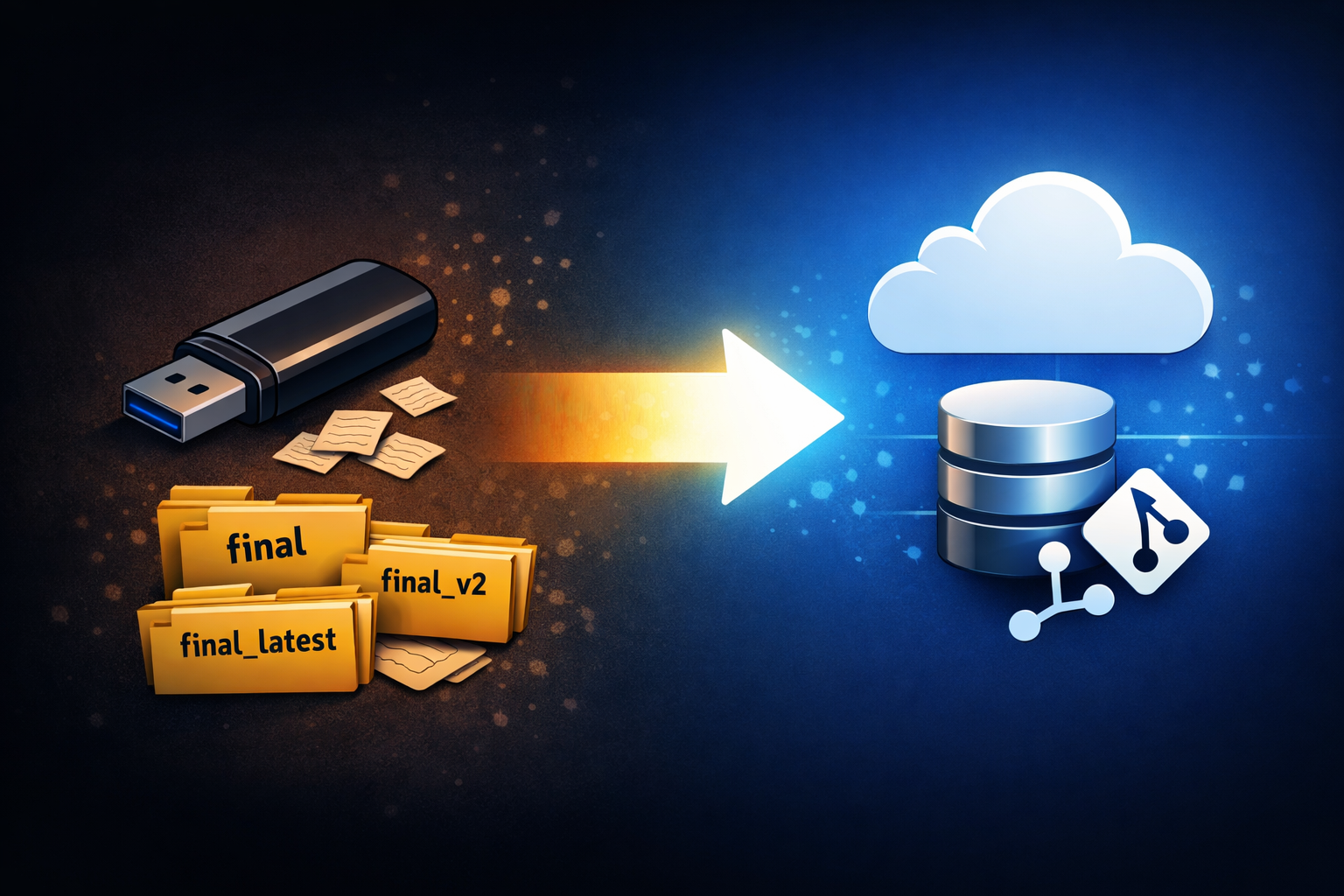
Pendrives. Emails. And folders named final_final_latest.
The Pendrive Era
Imagine this.
You are working on a project.
You’ve built most of the features, but you need help with one part.
So you copy your entire source code into a pendrive and give it to your friend.
Your friend takes the pendrive home and starts working.
Now the pendrive is with them.
You want to:
Fix a bug
Add a new feature
Improve existing code
But you can’t — because the code is not with you.
You wait.
The Problem Gets Worse
After a few days, your friend returns the pendrive.
They’ve added the feature — great!
But now they say:
“There’s a bug… I’m not sure where it is.”
Now what?
You don’t know what exact changes were made
You don’t know which file caused the bug
You don’t know when the bug was introduced
So what do you do?
You give the pendrive back again.
Now you’re waiting, and your friend is blocked too.
This is not collaboration — this is passing control.
The Famous Folder Names
To avoid losing work, developers started doing this:
project/
 ├── final/
 ├── final_v2/
 ├── final_latest/
 ├── final_latest_fixed/
 ├── final_latest_fixed_real/
Questions nobody could answer:
Which version is correct?
What changed between versions?
Who made the change?
Why was it changed?
Mistakes were common.
Work was overwritten.
History was lost forever.
The Core Problems Before Version Control
From the pendrive workflow, several serious problems emerged:
1. Overwriting Code
One developer’s changes could completely overwrite another’s work.
2. No Change History
There was no way to know:
What changed
When it changed
Why it changed
3. No Collaboration
Only one person could work at a time.
Others had to wait for:
The pendrive
The email reply
The latest ZIP file
4. Bug Tracking Was Guesswork
When a bug appeared:
No idea when it was introduced
No easy way to go back to a working version
The First Attempt at a Solution: Tracking Changes
To fix this, developers tried something new.
They added trackers:
To record what files changed
To compare old and new versions
This helped a little.
At least now you could:
See what your friend changed
Understand where the issue might be
But one big problem remained.
You still couldn’t work together at the same time.
Why This Failed for Teams
Even with tracking:
The pendrive was still physical
Control was still with one person
Collaboration was still slow
Modern software needs:
Multiple developers
Parallel work
Safe merging
Full history
The pendrive model simply could not scale.
The Big Shift: From Pendrives to Version Control
To solve all these problems, developers introduced a new idea:
“What if everyone had a copy of the code
and all changes were tracked automatically?”
This idea became Version Control Systems.
Version Control: The Modern Workflow
Instead of pendrives:
Everyone has the project locally
Changes are tracked automatically
History is never lost
Collaboration happens in parallel
This is where Git comes in.
How Git Solves the Pendrive Problem
Git allows developers to:
Track every change
Know who changed what and why
Work simultaneously
Go back to any previous version
Collaborate without waiting
Instead of:
“Wait for the pendrive”
We now have:
“Pull the latest changes and continue working”
Diagram Ideas (For Your Blog)
1. Pendrive-Based Workflow
Developer A → Pendrive → Developer B → Pendrive → Developer A
Slow, blocking, risky.
2. Version Control Workflow
Developer A → Repository ← Developer B
              ↑
          History & Tracking
3. Lost Timeline Without Version Control
File_v1 → File_v2 → File_final → File_final_fixed (v1 lost)
Final Thoughts
Version control did not appear because developers wanted fancy tools.
It appeared because:
Pendrives failed
Emails failed
Manual tracking failed
Git exists because collaboration without history is chaos.
Version control didn’t change how we code —
it changed how we work together.


